


Soorasamharam 2026 Quick Facts:
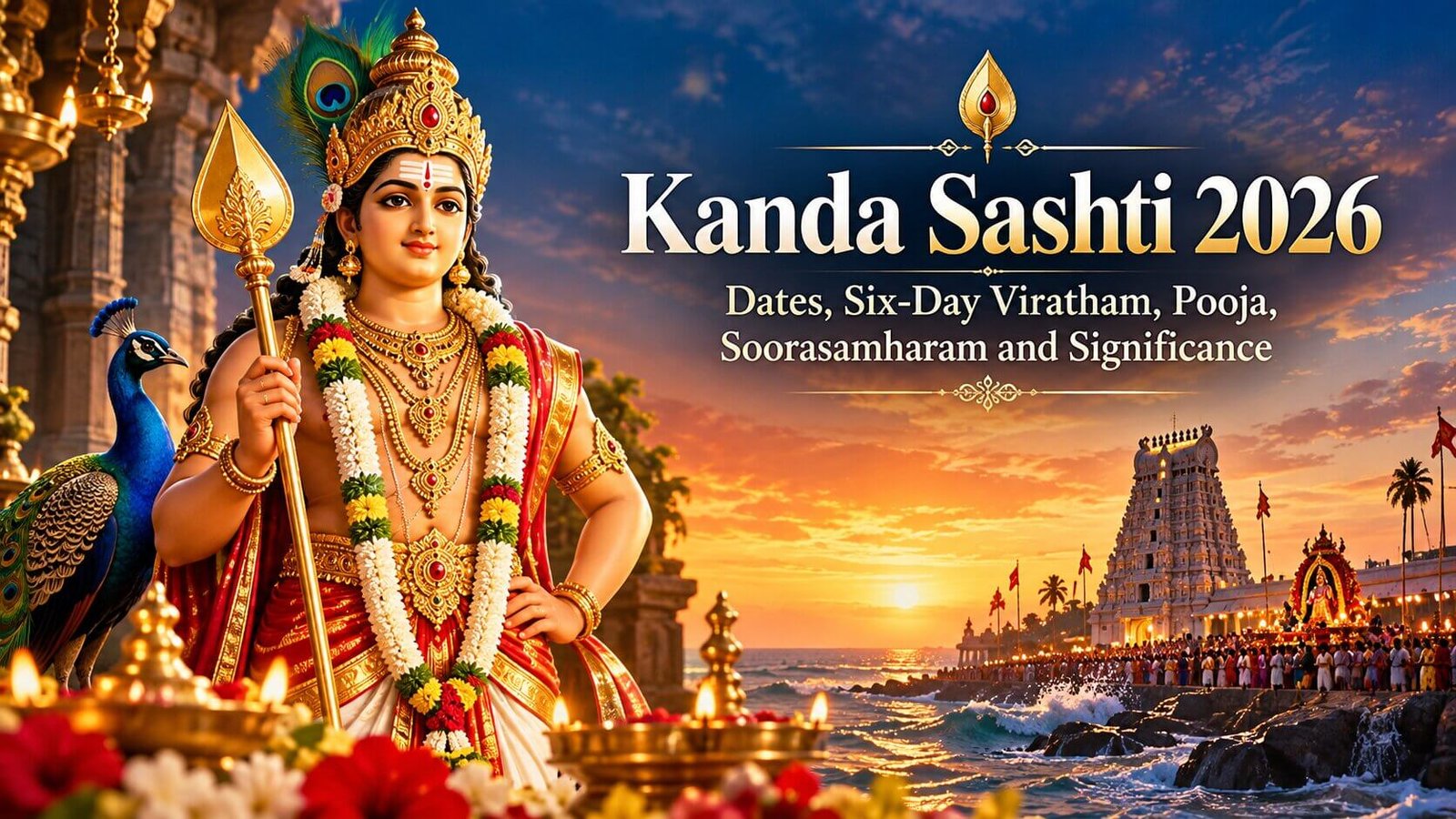
Soorasamharam 2026 will be observed on Sunday, November 15, 2026. The festival commemorates Lord Murugan’s victory over Surapadman, the powerful asura whose defeat is remembered as the triumph of dharma over arrogance and oppression.
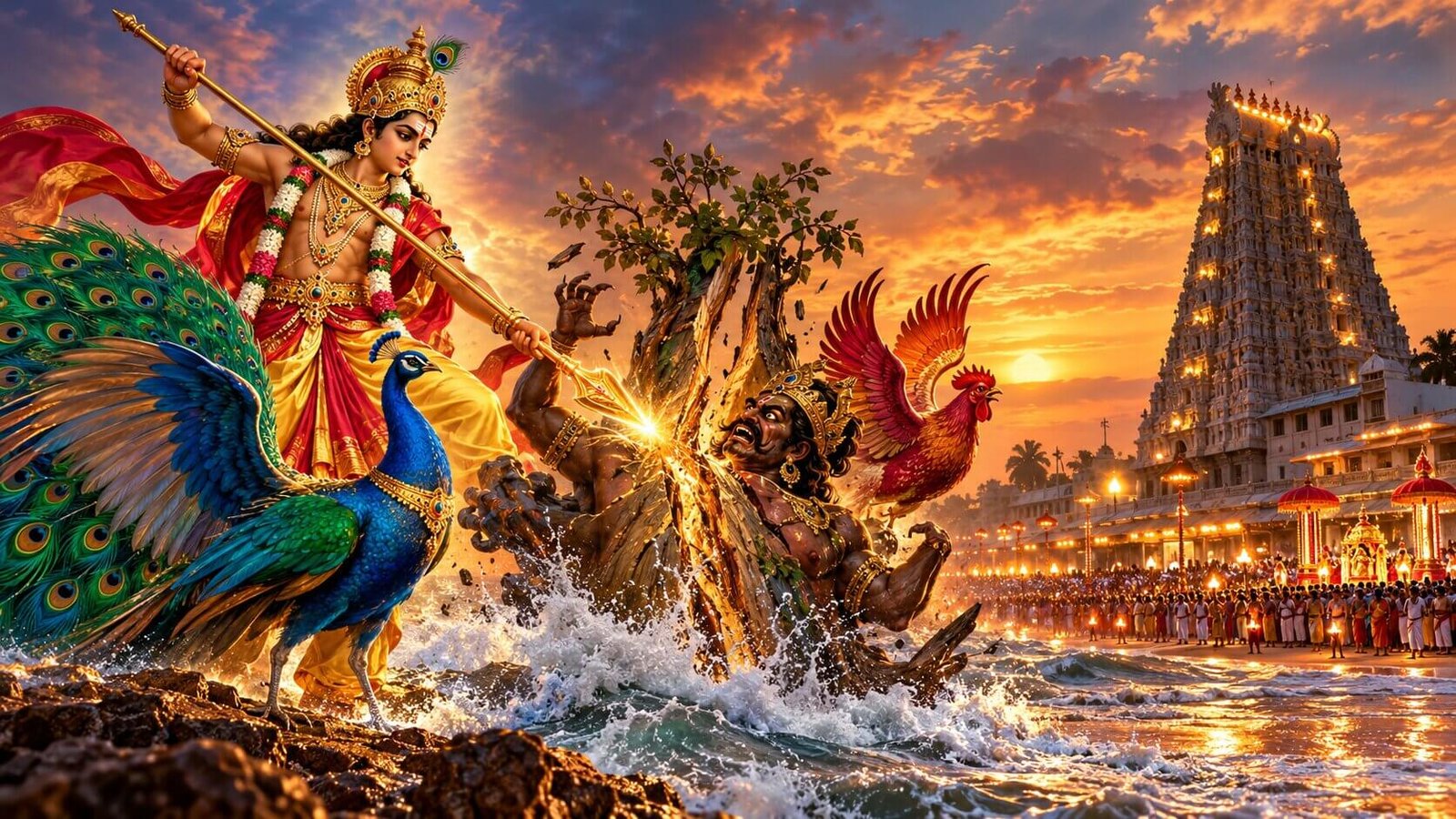
At Tiruchendur, one of Lord Murugan’s six sacred abodes, this victory is reenacted beside the sea. The appearance of Murugan’s sacred Vel, the confrontation with the asuras and the transformation of Surapadman into the peacock and rooster make Soorasamharam one of the most distinctive festivals in Tamil Hindu tradition.
Surapadman, the being who opposed Murugan, becomes associated with his vehicle and his banner. The battle ends in transformation and grace.
To understand why the festival matters, we need to look beyond the final moment of victory to the story preserved in the Tamil Kanda Puranam.
Soorasamharam 2026 – Date and Tiruchendur Timings
Soorasamharam takes place on the sixth day of the annual Kanda Sashti festival.
| Occasion | Date |
|---|---|
| Kanda Sashti Viratham begins | Tuesday, November 10, 2026 |
| Soorasamharam | Sunday, November 15, 2026 |
| Thirukalyanam | Monday, November 16, 2026 |
For Chennai, the published Shashti tithi timings are:
- Shashti begins: November 14, 2026, at 11:23 PM.
- Shashti ends: November 16, 2026, at approximately 2:00 AM.
These are lunar-calendar timings for Chennai, not the hours of the Tiruchendur temple reenactment. Panchangam timings can differ by location.
Why Is Soorasamharam on November 15?
Shashti begins late on November 14 and continues until early on November 16. It therefore covers all of November 15, including the afternoon and evening when the reenactment takes place.
The festival is observed on November 15 even though the Shashti tithi begins the previous night.
What Time Will Soorasamharam Take Place at Tiruchendur?
The principal reenactment is performed on the Tiruchendur seashore in the late afternoon or evening. The 2026 timings have not been announced at the time of writing. Check the temple’s official announcements for the procession and reenactment schedule, as darshan arrangements and access to the seashore may change.
For the full six-day calendar and fasting observances, read our guide to Kanda Sashti 2026 – Dates, Viratham and Pooja.
What Is Soorasamharam?
Soorasamharam, also written Surasamharam, Sura Samharam or Soora Samharam, refers to the defeat of Surapadman by Lord Murugan.
The Tamil name combines Sooran, a name associated with Surapadman, and samharam, a Sanskrit-derived term commonly used for destruction or subjugation.
Lord Murugan is revered as the divine warrior, the commander of the celestial forces and the embodiment of wisdom.
In the Kanda Puranam tradition, his battle against the asuras restores dharma after their misuse of power has brought suffering to the devas.
Devotees understand the festival as a celebration of overcoming destructive qualities and restoring spiritual order.
Its conclusion is distinctive because Surapadman is transformed into the peacock and rooster associated with Murugan. The story therefore brings together victory, wisdom, surrender and divine grace.
The Complete Story of Soorasamharam
The Tamil Kanda Puranam narrates Lord Murugan’s mission against the asuras, including Surapadman, Singamukhasuran and Tarakasuran.
The account below follows the principal episodes of the tradition. Details and sequencing may vary between retellings, regional performances and related Sanskrit traditions.
The Rise of Surapadman and His Brothers
Surapadman was a powerful asura whose strength came from austerities and divine boons.
Alongside his brothers, Singamukhasuran and Tarakasuran, he gained extraordinary influence.
However, the asuras did not use that power to uphold dharma. They oppressed the devas and disrupted the established order.
Surapadman’s confidence in his strength grew into arrogance. He came to believe that his power placed him beyond challenge. The devas, unable to overcome the asuras, sought divine intervention.
The story begins with a spiritual problem that remains relevant to human life: power without wisdom. Surapadman has extraordinary abilities, but his strength is no longer guided by humility, restraint or responsibility.
The Devas Seek Lord Shiva’s Help
The devas approach Lord Shiva and pray for deliverance.
According to tradition, divine sparks emerge from Shiva and are carried to Saravana Poigai, the sacred waters associated with Murugan’s manifestation. Six divine children appear and are nurtured by the Krittika maidens. Goddess Parvati embraces the six forms, uniting them as Shanmukha, the six-faced Lord.
Murugan is therefore known by many names, including Arumugam, Shanmukha, Skanda, Subramanya and Saravanabhava.
His manifestation marks the beginning of the divine response to the suffering of the devas. Murugan is entrusted with the mission of restoring dharma.
Goddess Parvati Bestows the Sacred Vel
Before the decisive battle, Goddess Parvati grants Lord Murugan the divine Vel.
This is one of the most significant moments in the Soorasamharam story.
The Vel is a spear, but in Murugan worship it represents much more than a physical weapon. It is associated with divine knowledge, spiritual clarity and the power to overcome ignorance.
The Vel becomes especially important in the final confrontation. The asura can assume many forms, yet he cannot escape the divine power of Murugan’s spear.
This is why the Vel is revered as a symbol of wisdom and spiritual strength.
Veerabahu and the Message to Surapadman
The Kanda Puranam tradition gives an important role to Veerabahu, known as Virapagu in Tamil. He serves Lord Murugan as a commander and messenger.
Before the decisive confrontation, Veerabahu is sent to communicate with Surapadman. Surapadman is given an opportunity to recognise Murugan’s authority and abandon his oppressive conduct. He refuses. His attachment to power prevents him from recognising the consequences of his actions.
The struggle becomes one between humility and pride, rightful authority and domination.
The Battle Against Tarakasuran
Tarakasuran is one of the major asuras opposed by Murugan.
His defeat forms part of the larger campaign to restore dharma, and it shows that the power of the asuras, however formidable, has limits.
Each confrontation brings Murugan closer to the final battle with Surapadman.
Singamukhasuran and the Lion Form
Singamukhasuran, whose name refers to a lion-faced form, is another powerful opponent. He confronts Lord Murugan during the conflict.
According to the Tiruchendur tradition, Murugan transforms Singamukhasuran into the lion vehicle of Goddess Shakti.
This episode introduces a theme that returns in the final encounter with Surapadman. Defeat does not always mean disappearance, and the overcoming of destructive power can be followed by transformation and a new purpose.
The Final Confrontation With Surapadman
Surapadman remains the central adversary. He has formidable strength and the ability to assume different forms. During the battle, he tries to overcome Murugan through these powers. Yet Murugan continues to prevail.
In the Tiruchendur tradition, Surapadman’s final attempt to escape defeat is to take the form of a great mango tree concealed in the sea.
Having exhausted other means of resistance, he tries to preserve himself through one more transformation. But Murugan recognises him.
Murugan Splits the Mango Tree With His Vel
Lord Murugan directs the sacred Vel towards the mango tree. The Vel splits the tree into two. From the divided form emerge a peacock and a rooster.
The peacock becomes Murugan’s vahana, or divine vehicle. The rooster becomes the emblem on his banner. This is the climactic moment of Soorasamharam.
The same Vel that ends Surapadman’s resistance also brings about his transformation. Surapadman does not continue as Murugan’s enemy, and his transformed forms become permanently associated with the deity he opposed.
Why Did Surapadman Become a Peacock and Rooster?
The transformation of Surapadman is one of the most meaningful parts of the Soorasamharam story.
Why did Murugan make the peacock his vehicle? Why does a rooster appear on his flag? And why does a story of divine victory conclude with the transformation of the defeated asura?
The Peacock – From Opposition to Divine Service
The peacock, known as Mayil in Tamil, is Murugan’s most familiar vehicle. In Murugan iconography, it stands beside the deity and forms an important part of his divine appearance.
According to the Soorasamharam story, the peacock emerges from one half of Surapadman’s transformed form. Its place beside Murugan therefore marks a remarkable reversal. What once opposed the deity now serves as his vehicle.
Devotional interpretations sometimes understand the peacock as a symbol of pride brought under divine wisdom, so that Murugan’s command over it stands for the overcoming of uncontrolled ego and desire.
This is one symbolic reading of the tradition, and other meanings are possible.
The Rooster – The Emblem of Murugan’s Banner
The rooster, called Seval in Tamil, emerges from the other half of Surapadman’s transformed form. It becomes the emblem on Murugan’s flag.
The rooster is often associated with alertness and awakening, since its cry announces the arrival of dawn. For devotees, this imagery may suggest the awakening of knowledge after the darkness of ignorance.
Its presence on Murugan’s banner also preserves the memory of the final battle.
Was Surapadman Killed or Forgiven?
Soorasamharam is commonly described as the destruction or defeat of Surapadman. Yet the story also describes his transformation, and the two should be understood together.
Surapadman’s oppressive power is overcome, and his identity as Murugan’s adversary ends. His transformed forms are given a place in Murugan’s divine service.
The Tiruchendur temple’s account adds that Murugan gave the asuras peruvazhvu, a great blessing, before freeing the devas.
Many devotees understand this conclusion as grace following the defeat of arrogance. Divine victory here involves transformation as well as the overcoming of destructive power.
The Three Asuras and Mummalam – The Deeper Meaning of Soorasamharam
In Tamil Saiva Siddhanta philosophy, Anavam, Kanmam and Maya are collectively known as Mummalam, the three impurities or bonds that limit the soul.
They form part of Pasam (bondage), which prevents the individual soul (Pasu) from fully realising its relationship with the Divine (Pathi).
The Tiruchendur temple’s account associates the destruction of the three asuras with the destruction of these bonds. The defeat of the asuras represents the overcoming of the limitations that keep the soul bound to worldly existence.
Anavam – The Root Impurity
Anavam (ஆணவம்) is considered the fundamental impurity, or Moola Malam, in Saiva Siddhanta.
It is not simply pride or selfishness. It is a beginningless obscuring condition that limits the soul’s knowledge and awareness of its true nature.
Anavam causes the soul to experience itself as separate, limited and dependent on the narrow perception of “I” and “mine.”
Surapadman’s overwhelming pride provides a devotional illustration of this limitation. Despite his extraordinary powers, he cannot recognise the divine reality before him.
Kanmam – The Bondage of Actions
Kanmam (கன்மம்), also called Vinai, refers to karma, meaning actions and their consequences.
According to Saiva Siddhanta, the soul accumulates karma through its thoughts, words and deeds.
Both favourable and unfavourable actions produce consequences that bind the soul to repeated experiences of pleasure and suffering.
The conduct of the asuras illustrates how actions driven by ignorance and attachment create further bondage. Their downfall reminds devotees that power and action must be guided by dharma.
Maya – The Material Cause of Worldly Experience
Maya (மாயை) has a specific meaning in Saiva Siddhanta.
It is not merely an illusion or something that does not exist. Maya is understood as a real material principle from which the body, senses and material world arise.
Through these instruments, the soul experiences the consequences of karma and gradually progresses towards spiritual understanding. Maya therefore has a role in the soul’s journey, even while it remains one of the bonds associated with worldly existence.
In devotional interpretation, the changing forms Surapadman assumes can encourage reflection on the difference between external appearances and spiritual understanding.
How Are the Three Bonds Overcome?
Saiva Siddhanta teaches that liberation, or Mukti, is not achieved merely through physical strength or intellectual understanding.
The soul progresses through righteous conduct, spiritual discipline, devotion and, ultimately, the grace of Lord Shiva (Thiruvarul).
Through divine grace, the obscuring power of the three bonds is overcome, allowing the soul to attain liberation.
This gives Soorasamharam a deeper philosophical meaning. Murugan’s victory can be contemplated as the triumph of divine wisdom and grace over the bonds that limit the soul.
The transformation of Surapadman adds another dimension to this reading, because the battle ends in blessing as well as defeat.
This is a devotional interpretation of the story. It does not claim that the three asuras are identified with the three impurities in every version of the Kanda Puranam.
The Vel in Tamil Murugan Worship
The Vel occupies a special place in Tamil religious culture. It appears in temple worship, devotional songs, festival processions and household prayer spaces. The familiar invocation Vetri Vel Muruganukku Arogara celebrates the victorious Vel of Lord Murugan.
During Soorasamharam, the connection between Murugan and the Vel becomes especially visible, because the confrontation with the asuras ends through the sacred spear.
For devotees, the Vel is a reminder that courage needs wisdom to guide it.
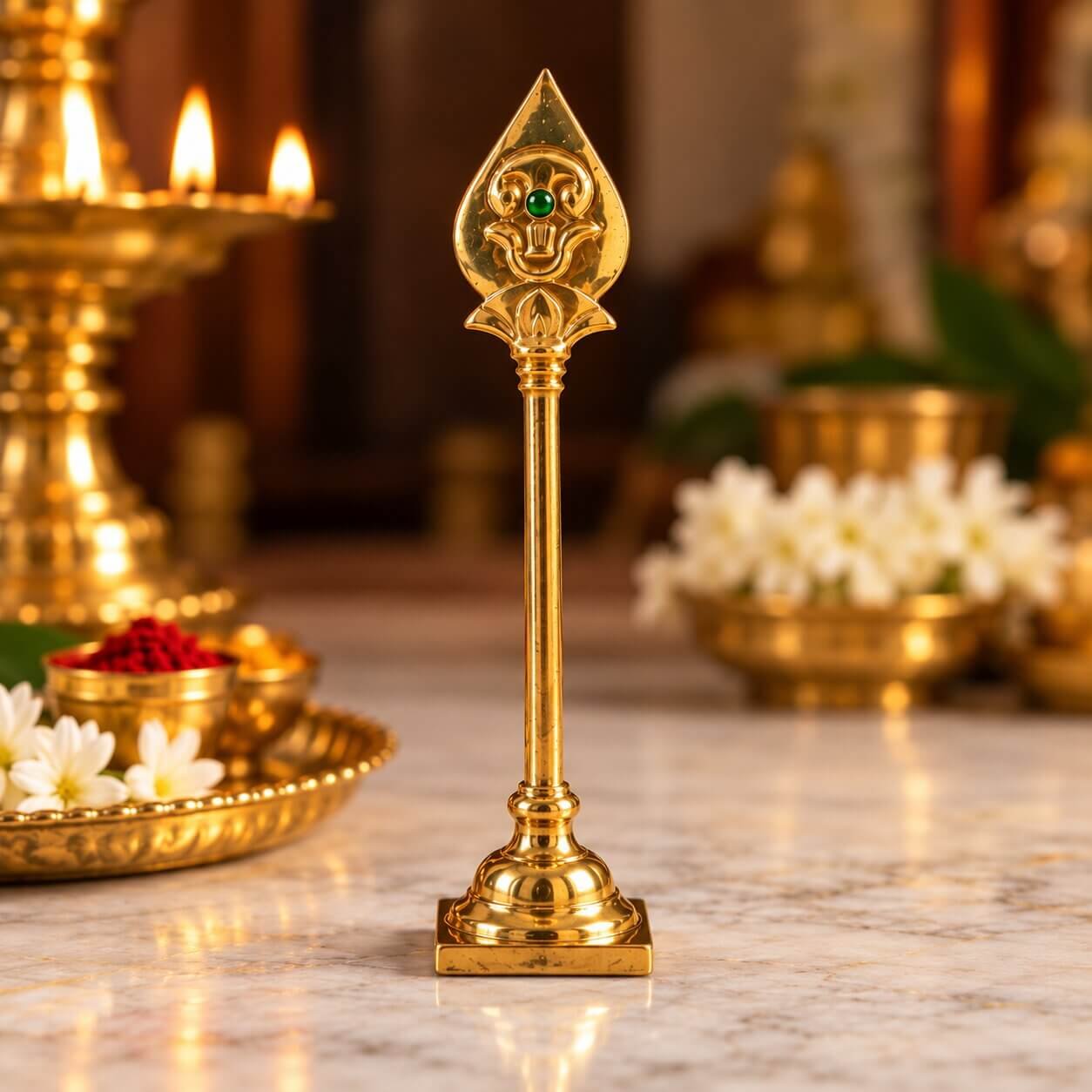
Worshipping the Vel at Home
In many Murugan worship traditions, the Vel is honoured as a sacred representation associated with the deity.
Some households place a Vel beside a Murugan idol. Others make it the central focus of prayer, offering fresh flowers, sandalwood paste and kumkum according to family custom. Worship before a Murugan image is equally complete.
For devotees who wish to include a traditional Vel in their prayer space, Anugrah Aura’s 6-inch Brass Murugan Vel is available. It stands on its own square pedestal, so no additional stand is needed.
Tiruchendur Soorasamharam – The Sacred Seashore Celebration
Tiruchendur Subrahmanya Swamy Temple is one of the six sacred abodes of Lord Murugan, collectively known as the Aarupadai Veedu.
Unlike several other major Murugan temples on hills, Tiruchendur stands beside the Bay of Bengal.
Why Is Soorasamharam Reenacted Beside the Sea?
The Tiruchendur tradition describes Surapadman hiding as a mango tree in the sea.
The seashore is therefore part of the sacred geography of Murugan’s victory, and the events leading to the destruction of the three asuras are enacted there.
This link between story, place and ritual explains why Tiruchendur is so important during Kanda Sashti.
The Role of Sri Jayanthinathar
Sri Jayanthinathar is the processional form of Lord Murugan at Tiruchendur. During the festival, special worship is offered before the deity is taken in procession towards the shore.
For devotees, the procession is a sacred event in which the temple’s established ritual tradition brings the story of Murugan’s victory into the present.
How the Tiruchendur Reenactment Unfolds
The festival day begins early, with the temple sanctum opening around 1 AM in recent years, followed by special worship and abhishekam. The processional deity is then taken towards the seashore in the afternoon.
The deity first slays the asura in the guise of an elephant and a lion. He then splits the mango tree, from which a rooster and a peacock emerge, and the real Surapadman is slain later amid the chants of the gathered devotees.
The reenactment condenses the story, so its order differs slightly from the Kanda Puranam account above.
Devotees chant “Vetrivel Muruganukku Arogara” and celebrate the victory of the Vel. The temple’s own account puts attendance on Soorasamharam day at more than five lakh devotees.
Chaya Abhishekam – A Distinctive Tiruchendur Ritual
After Surapadman is destroyed, Tiruchendur observes a ritual called Chaya Abhishekam.
The word chaya refers to an image or reflection. A mirror is placed before the deity, and abhishekam is performed for the mirror image of Lord Murugan.
This ceremony belongs to the temple’s own worship tradition. It should not be confused with ordinary household abhishekam or treated as a ritual that devotees must reproduce at home.
The temple’s account then describes Lord Murugan performing puja to Lord Shiva, which ties the festival to the wider Saiva devotional tradition.
Visiting Tiruchendur for Soorasamharam 2026
Devotees planning to attend on November 15 should expect very large crowds. Soorasamharam is one of the temple’s major annual events and draws pilgrims from across Tamil Nadu and beyond.
Planning Your Visit
Arrange accommodation and transport well in advance. Traffic routes, parking arrangements and access to areas near the seashore may change during the festival. Follow official instructions regarding darshan queues and procession viewing areas.
Families travelling with children or elderly relatives should plan for long periods of standing and waiting. Be prepared for weather conditions and coastal safety restrictions.
Confirm the 2026 programme with the temple’s announcements before travelling.
Can You Watch Tiruchendur Soorasamharam Live?
Tamil television channels and online news platforms often provide live coverage of the celebrations.
Broadcasters and streaming links change from year to year, so check the temple’s announcements and verified broadcaster channels nearer November 15.
Avoid relying on old livestream links labelled with previous festival years.
Other Temples Where Soorasamharam Is Observed
Although Tiruchendur is especially famous for Soorasamharam, other Murugan temples observe the festival too.
Thiruporur, near Chennai, is traditionally linked with Murugan’s battle. The Tamil word por means battle.
Devotees also look for festival information from Marudhamalai near Coimbatore and other Murugan shrines.
Ceremonies differ from temple to temple. Some hold elaborate public reenactments, while others emphasise special abhishekams, processions and devotional worship.
Confirm the arrangements with the temple you plan to visit.
How Can Devotees Remember Soorasamharam at Home?
Not everyone can travel to Tiruchendur, and many families observe Soorasamharam in their own pooja rooms.
A simple observance may include lighting a lamp, offering flowers before Lord Murugan and reciting a familiar devotional hymn.
Some devotees read the story of Surapadman or chant Kanda Sashti Kavacham. Others offer prayers before the sacred Vel.
The purpose is to remember Murugan’s victory and reflect on its spiritual significance. A household does not need to reproduce the reenactment or temple rituals.
Thirukalyanam – From Victory to Divine Union
Soorasamharam is followed by Thirukalyanam, the celestial wedding of Lord Murugan with Goddess Deivanai and Goddess Valli. In 2026, it falls on Monday, November 16.
Murugan’s marriage to Deivanai is also especially associated with Tirupparankundram, another of the six sacred abodes. At Tiruchendur, the temple conducts the wedding on the day after Soorasamharam as part of the festival.
The movement from Soorasamharam to Thirukalyanam gives the festival its distinctive progression.
The story begins with oppression and disorder.
It moves through divine intervention and battle.
It reaches its climax with Surapadman’s defeat and transformation.
Finally, it turns towards auspiciousness, celebration and harmony.
For devotees, this progression offers a broader understanding of victory. The purpose of overcoming destructive forces is the restoration of peace and dharma.
Frequently Asked Questions About Soorasamharam 2026
1. When is Soorasamharam in 2026?
Soorasamharam will be observed on Sunday, November 15, 2026. It is the concluding day of the annual Kanda Sashti festival.
2. What time is Tiruchendur Soorasamharam in 2026?
The reenactment is held on the seashore in the late afternoon or evening. The exact 2026 timings should be confirmed through the temple’s official announcements.
3. What is the story of Soorasamharam?
Lord Murugan battles Surapadman and the asuras who oppressed the devas. He ultimately splits Surapadman’s mango-tree form with the sacred Vel, and it becomes the peacock and rooster associated with Murugan.
4. Who is Surapadman?
Surapadman is a powerful asura in the Kanda Puranam tradition. His arrogance and oppression of the devas lead to his confrontation with Lord Murugan.
5. Why did Surapadman turn into a mango tree?
According to the Tiruchendur tradition, Surapadman takes the form of a mango tree concealed in the sea as his final attempt to escape defeat.
6. Why did Murugan make Surapadman his peacock?
The peacock emerges from one half of Surapadman’s transformed form. Its place as Murugan’s vehicle shows a former adversary brought into divine service.
7. What does the rooster on Murugan’s flag represent?
The rooster emerges from the other half of the mango tree and becomes the emblem on Murugan’s banner. Devotional interpretations also associate it with alertness and awakening.
8. What is the significance of the Vel in Soorasamharam?
The Vel is the sacred spear through which Murugan defeats Surapadman. Devotees associate it with divine wisdom, courage and the removal of ignorance.
9. Why is Tiruchendur famous for Soorasamharam?
Tiruchendur is traditionally associated with Murugan’s final victory over Surapadman. Its seaside setting is where the annual reenactment takes place.
10. What is Chaya Abhishekam at Tiruchendur?
Chaya Abhishekam is a temple ritual in which abhishekam is performed for the mirror image of Lord Murugan after Surapadman’s destruction.
11. Is Soorasamharam celebrated only at Tiruchendur?
No. Other Murugan temples also observe Soorasamharam, although their ceremonies and reenactments differ according to local tradition.
12. Can I worship the Vel on Soorasamharam?
Yes. Devotees who follow Vel worship traditions may offer prayers before the sacred Vel. Worship can also be performed before a Murugan image or idol.
13. What happens after Soorasamharam?
Thirukalyanam, the celestial wedding of Murugan with Deivanai and Valli, follows on the next day. In 2026, it is observed on November 16.
14. Is Soorasamharam the same as Kanda Sashti?
Soorasamharam is the culminating event of the annual Kanda Sashti festival. Kanda Sashti refers to the broader six-day observance.
15. What is the deeper meaning of Soorasamharam?
The festival represents the victory of dharma over oppression. In devotional interpretation, it also symbolises the overcoming of spiritual bondage through divine wisdom and grace.
Soorasamharam – When Victory Becomes Grace
The most remarkable part of Soorasamharam comes after the victory.
The mango tree is split by the Vel, yet the story does not end in emptiness. The peacock becomes Murugan’s vehicle. The rooster becomes his banner.
What once stood against the divine becomes part of its sacred presence.
This is why Soorasamharam continues to resonate with devotees across generations. It reminds us that strength must be guided by wisdom, that arrogance can be overcome and that transformation remains possible.
On November 15, 2026, as devotees gather at Tiruchendur and in Murugan temples around the world, the victorious Vel will once again become the centre of prayer and celebration.
May the festival inspire courage, humility and clarity.
Vel Vel Muruga! Vetri Vel Muruga!
Related Guides
- Kanda Sashti 2026 – Dates, Six-Day Viratham, Pooja and Significance
- Simple home pooja guide
- Daily pooja essentials
- How to do daily home pooja